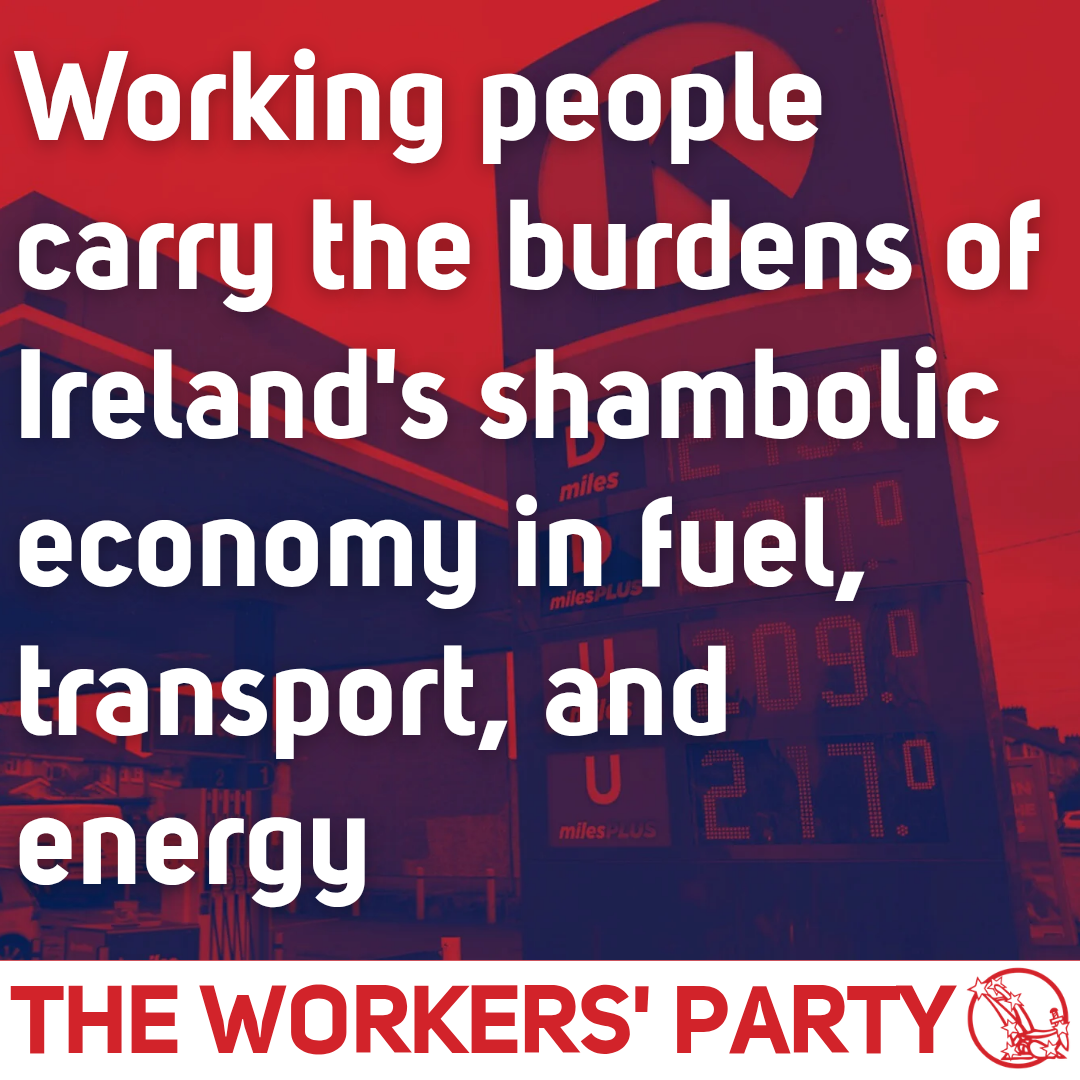
In fuel, transport, and energy, Fine Gael and Fianna Fáil expect the Irish working class to shoulder the burden of the shambolic economy that they have built.
Petrol is crossing €2 a litre. The cause is a conflict in the Middle East which Ireland had no hand in starting and has no power to end. Approximately one-fifth of the world’s oil supply passes through the Strait of Hormuz, now effectively closed. This comes on top of years of elevated energy costs driven by the war in the Ukraine. The government has offered spin and sympathy while quietly pocketing the increased tax take. The Chief Executive of Fuels for Ireland put it plainly: Ireland is a price taker. We are too small to affect international markets. That is their philosophy: accept your lot.
These crises land hardest on workers already pushed to the edges by the housing crisis. Almost half of all commuters travel 30 kilometres or more each way, more than double the figure at the last census, because they cannot afford to live near their work. Dublin was ranked the third most congested city in the world in 2025. Many commuters have no alternative to the car. Many of them could work from home, and the pandemic proved it, yet the right to do so does not exist in law, and the government will not create it. Workers in roles that can be done remotely must have a legal right to do so. The state must invest in rail to make life outside Dublin viable — but investment must mean real improvement in public transport. The current approach is all stick and no carrot: planned congestion charges and parking restrictions without the infrastructure to give people an alternative. This is not the 19th century, there shouldn’t be this difference between life in a town and the country.
The answer to energy dependency is public ownership and nuclear power. The 1999 ban on nuclear energy was a political decision made in a different era. Modern small modular reactors are safer and scalable to a small island economy. France generates over 70% of its electricity from nuclear power and has among the lowest prices and emissions in Europe — and President Macron has recently reaffirmed his commitment to expanding that capacity. Finland has just brought the most powerful nuclear reactor in Europe online. Across the continent, the direction of travel is clear: even the European Commission has acknowledged that Germany’s decision to shut down its reactors was a mistake. Czechia, in recent years, has brought new reactor builds online. To be left behind this emerging consensus would be an act of deliberate self-harm. State-owned nuclear capacity, combined with our wind resources under public ownership, could make Ireland take great strides towards energy independence and break our dependence on fossil fuels. Renewable energy alone saved this country €6.7 billion over the past four years. Public ownership of our energy is not a radical demand. It is common sense.
The current government will not deliver any of this. Three companies now pay almost half of the state’s corporation tax. That is the economy that Fine Gael and Fianna Fáil have built. It requires the approval of Washington and the obedience of Brussels. EU state aid rules are routinely bent for larger member states when it suits them, yet Ireland is expected to accept constraints on public ownership and industrial policy in the name of the single market.
Ireland is an island and we need to act like one; sovereign in energy, more self-sufficient, and with strategic industries in public hands. The great only appear great because we are on our knees: let us arise!